


A quarterly review gives us a chance to take stock. A long-term plan gives us a way to decide what to do with what we learn. As we look back on Q3 and enter the final months of the year, we’re asking the questions that guide our work in every market. Are we taking risks that serve our clients’ goals? Do the investments we own reflect the convictions that guide us? And are we holding ourselves accountable for the decisions entrusted to us?
Diversification starts with understanding what we own. A portfolio can hold many investments and still depend heavily on the fortunes of a few companies or one part of the market. Looking across asset classes, sectors, and regions helps us see where those dependencies lie. We expect different parts of a portfolio to lead at different times. Reviewing them together helps us judge whether each holding still serves the long-term plan.
Theological screening brings our faith into decisions about what we own. Investing gives us a stake in real businesses, so what those businesses do matters. Screening helps us consider how their activities align with the Christian convictions that guide our investment approach. We consider that alignment alongside each investment’s risks, costs, and role in the portfolio.
Our CEFEX recertification reflects a commitment to accountability. The Centre for Fiduciary Excellence conducts an independent annual assessment of the investment practices covered by its certification. Fiduciary responsibility shows up in how we evaluate costs, identify and address conflicts, and document why a recommendation serves a client’s interests. Independent review gives those practices a regular check. (CEFEX Certification and Renewal Process)
Faithful stewardship means caring for what has been entrusted to us with patience and purpose. For some clients, that means preparing for retirement or supporting family. For others, it means sustaining a ministry or making generosity possible for years to come. Those commitments give us a longer horizon for the decisions we make today. Thank you for trusting us to help you steward what you’ve been given.
This quarterly investment newsletter contains valuable commentary that we hope informs you and your ministry’s own understanding of the market. The Foundation remains available to assist you, whether you have questions about what you read here or would like to talk through how recent market developments relate to your long-term goals.
ECONOMIC OUTLOOK
| Economic fundamentals remain firm, but the hurdle is rising for future returns. Business investment and resilient consumers continue to drive growth, with corporate earnings on pace for a third consecutive year of double-digit gains: a streak not seen in two decades. However, persistent inflation, elevated energy costs, rising bond yields, and policy uncertainty ahead of midterm elections leave less room for error. Growth can continue, but a higher cost of capital demands greater discipline. |

HEADWINDS
Inflation Forces Fed Action
- Elevated oil and fuel costs have reinforced inflationary pressures. In response, the Fed raised the federal funds rate for the first time since 2023 and signaled further tightening could be required.
Financing Costs Keep Rising
- Government borrowing, corporate bond issuance, and Al related investment are competing for capital. This has placed additional upward pressure on long-term interest rates.
Midterms Magnify Policy Risk
- Atop the usual policy uncertainty before midterm elections, growing opposition to data center development and calls for Al guardrails could enter the political spotlight. potentially slowing this leading source of investment and growth.

TAILWINDS
Growth Proves Rate-Resilient
- The economy has remained resilient despite higher borrowing costs. Although rising yields have pressured housing and rate-sensitive sectors, they have not derailed business investment or consumer spending.
Investment Fuels Profits
- Al infrastructure spending is extending across technology, construction, power, and related industries, driving economic growth and corporate profits. Rising earnings expectations, rather than higher valuations, have fueled market gains, providing a firmer footing for future returns if companies can deliver.
Consumers Power Through
- Despite weak sentiment, a stable labor market and rising household wealth have supported consumer spending, cushioning the effects of inflation and higher energy costs.
MARKETS MIXED AMID RISING PRESSURE
| Markets delivered mixed results in the third quarter. Strong earnings supported U.S. large- cap stocks, but rising energy prices, higher long-term interest rates, and geopolitics pressured markets. Commodities led by a wide margin, while more rate-sensitive categories, including small-cap stocks struggled. |
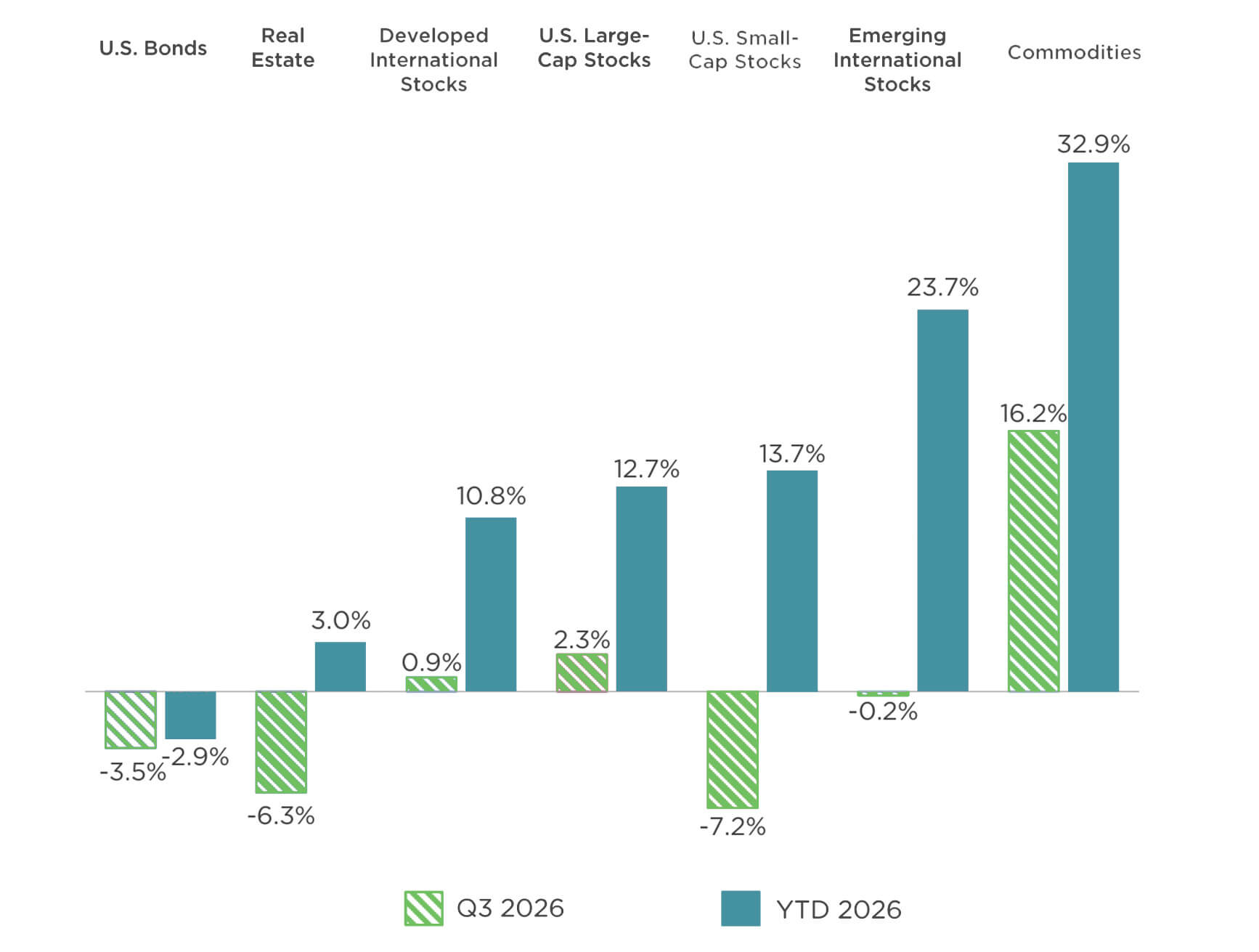
- U.S. large-cap stocks edged higher. with varied performance across sectors. Energy and technology stocks led the pack while more interest-rate sensitive sectors lagged.
- U.S. small-cap stocks declined amid rising financing and energy costs. Despite the setback, small cap returns are positive for the year.
- International returns were muted. Developed markets were mostly flat, while emerging markets declined slightly.
- Commodities surged 16%, driven largely by higher energy prices amid lingering global conflict and supply shortages.
- Core U.S. bonds declined as Treasury yields rose sharply, with the 10-year Treasury yield climbing above 5% to its highest level since 2002.
Asset class returns are represented by the following indexes: Bloomberg U.S. Aggregate Bond Index (U.S. bonds), S&P 500 Index (U.S. large-cap stocks), Russell 2000″ (U.S. small-cap stocks), MSCI EAFE Index (international developed market stocks), MSCI Emerging Market Index (emerging market stocks), Dow Jones U.S. Real Estate Index (real estate). and Bloomberg Commodity Index (commodities). Past performance is no guarantee of future results. Indexes are unmanaged; do not incur management fees, costs, and expenses; and cannot be invested in directly. Please refer to the index definitions and other important disclosures provided at the end of this presentation.
A NEW ERA FOR THE FEDERAL RESERVE
A leadership transition and persistent inflation reshaped monetary policy in 2026. In September, the Fed raised its target range for the first time since 2023, concluding the economy was strong enough to absorb higher interest rates. This marked the first policy test under new Chair Kevin Warsh, whose reduced reliance on forward guidance has left investors interpreting policy through economic data and market signals.
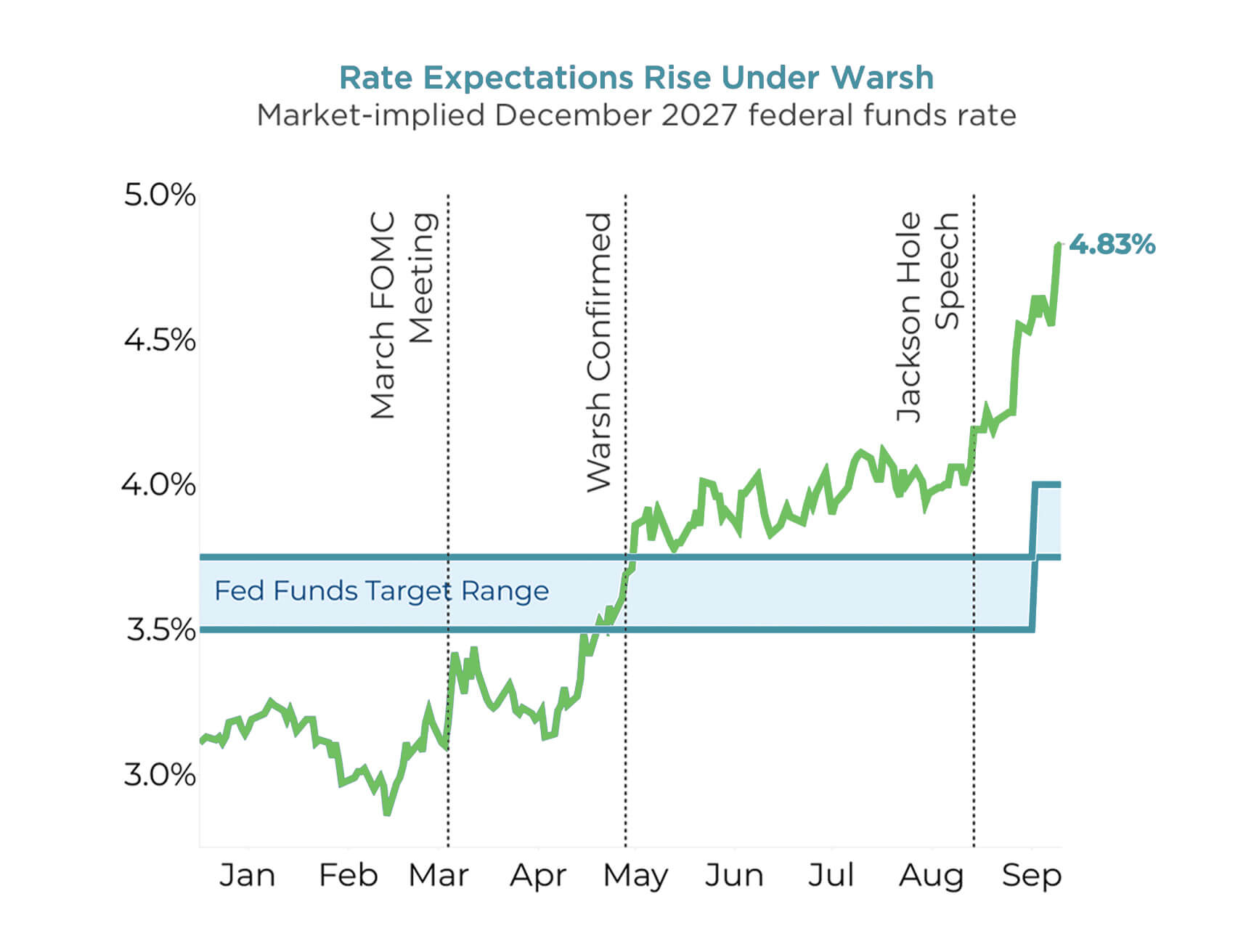
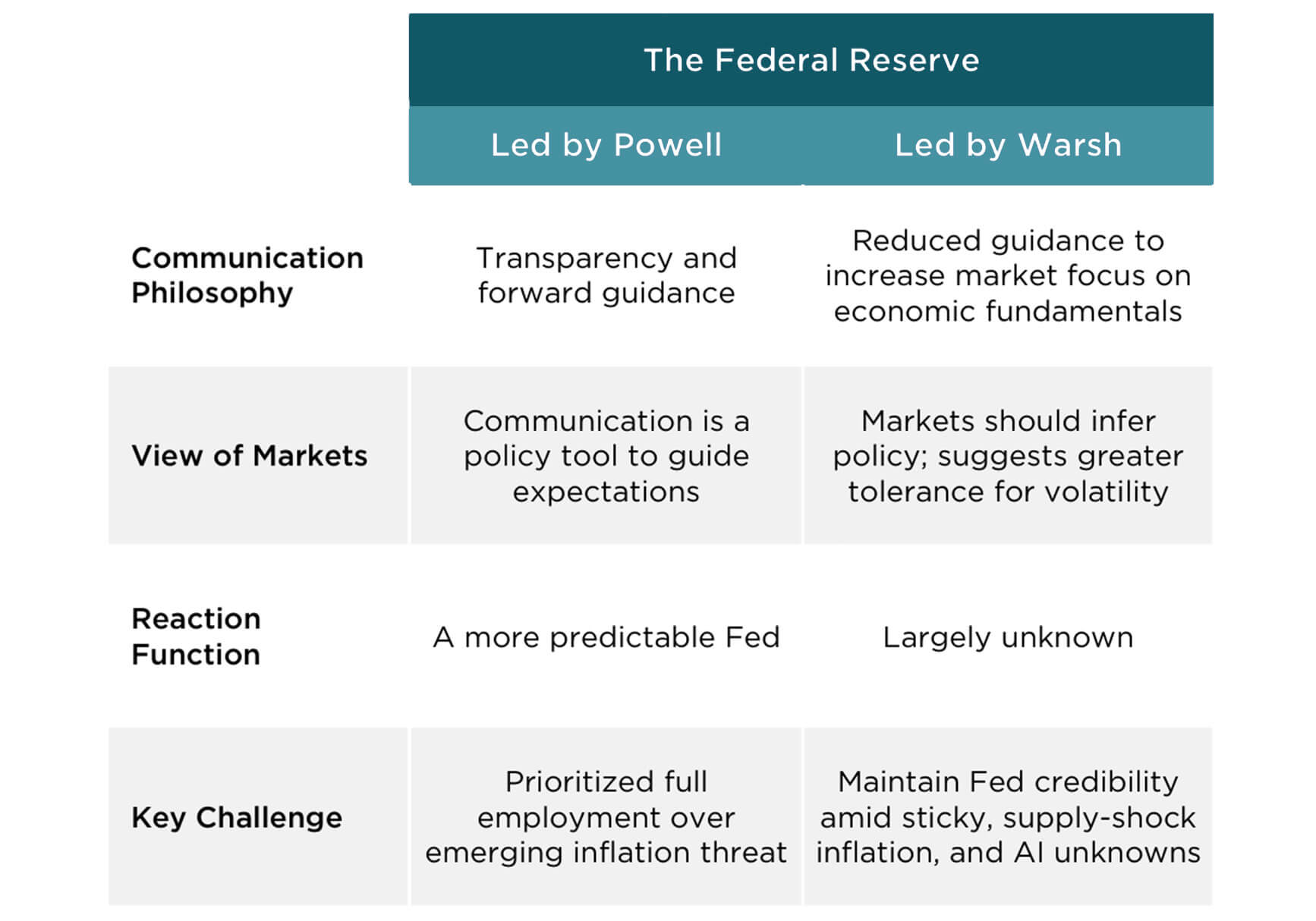
- Persistent inflation prompted the Fed to raise rates in September, reinforcing its commitment to price stability. Economic resilience gave policymakers room to act.
- Markets now anticipate a higher policy path, reflecting expectations that additional tightening may be needed. With less forward guidance, each inflation report, economic release, and market signal may carry greater weight as investors assess what comes next.
Sources: FactSet. CAPTRUST research. Market-implied December 2027 federal funds rate as of 9.24.2026. FOMC stands for Federal Open Market Committee.
THE Al BUILDOUT MEETS LOCAL RESISTANCE
| The rapid pace of Al development is creating physical and social strains that are reshaping public opinion and policy debate. While data centers may generate tax revenue and strengthen U.S. competitiveness, public concerns about land, water, power consumption, and infrastructure costs are mounting. As these issues gain attention, could opposition constrain the Al investment cycle? |
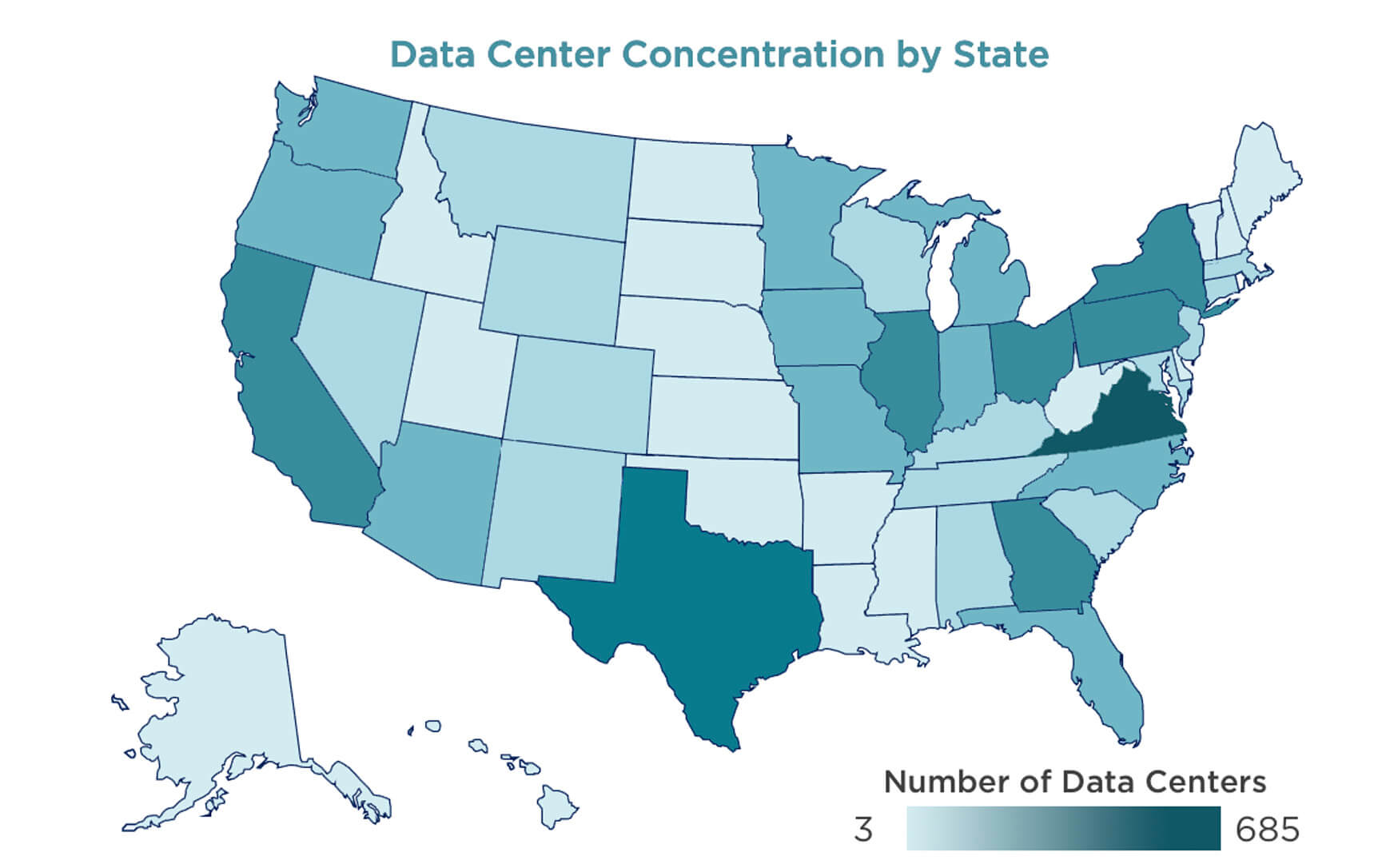
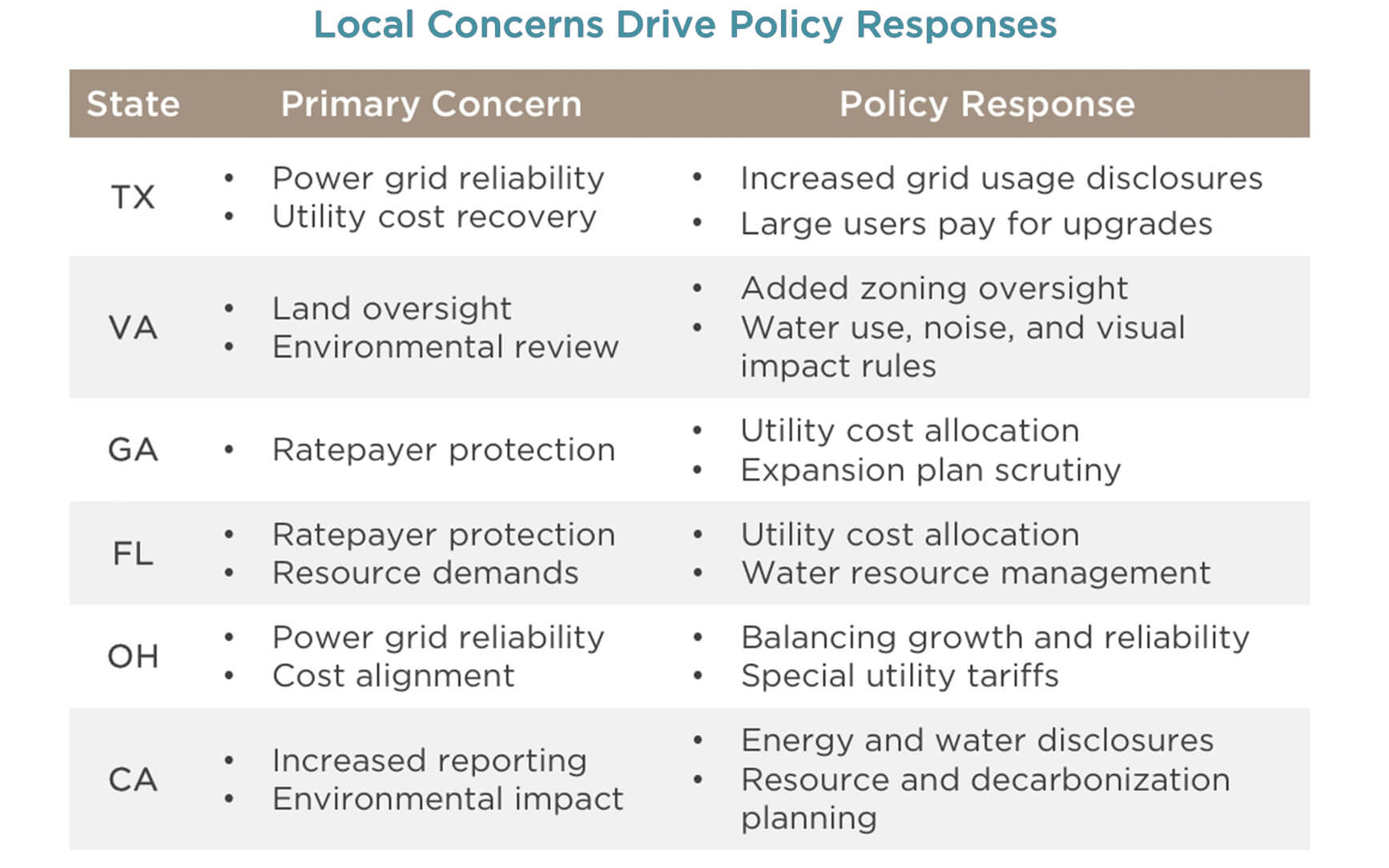
- Data centers can bring jobs, tax revenue, and infrastructure investment to host communities, while also increasing demands on power, water, land, and public resources. This uneven mix of local benefits and pressures is fueling debate over how development should proceed.
- Because development is concentrated in a relatively small number of states, changes in permitting, cost allocation, or resource requirements could affect the pace and economics of the broader buildout.
- As the midterms approach, these concerns could gain political momentum, adding uncertainty to one of the economy’s most important sources of investment and growth.
Sources: FactSet, CAPTRUST research, BEA, St. Louis Fed. Left panel: Computing capex = private investment in information processing equipment and software. Right panel: Semiconductors and semiconductor equipment industry group (S&P 500 Index). †YTD returns through 6.30.2026.
MULTIPLE FORCES DRIVE YIELDS HIGHER
| Inflation, economic growth, and Fed policy all drive interest rates, but they’re not the only forces at work. Rising fiscal deficits have led to increased government borrowing, while corporations have issued more debt to finance infrastructure investments. Together, public and private financing needs have intensified competition for investor capital. requiring higher yields to attract buyers. |
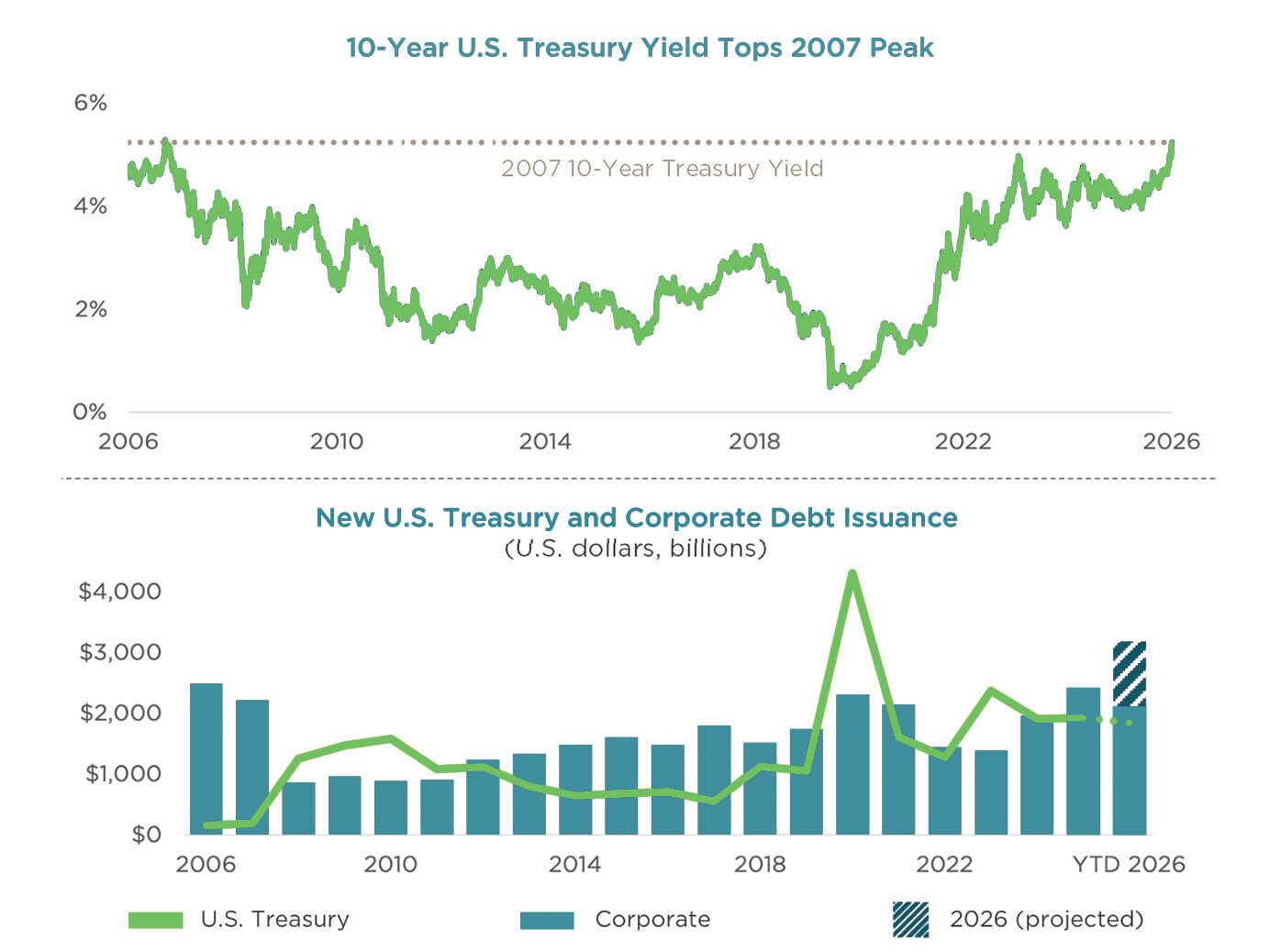
- The 10-year Treasury yield rose above 2007 levels as investors demand more compensation to lend for longer.
- If current trends continue, corporate bond issuance could reach $3 trillion in 2026.
Several Forces Are at Work
- Persistent Inflation: Elevated energy costs and slow progress toward the Fed’s 2-percent target support higher interest rates.
- Economic Strength: Resilient growth and strong capital investment increase demand for financing.
- Capital Competition: Large government deficits require bond issuance, just as Al spending drives corporate borrowing to multi-decade highs.
- Higher rates raise borrowing costs and the hurdle for new investment, placing pressure on weaker balance sheets.
- For investors, rising yields pressure current bond prices but create a stronger starting point for future income and long-term returns.
Sources: FactSet, U.S. Treasury, Board of Governors of the Federal Reserve via FRED, CAPTRUST research. Data as of 9.30.2026.
EARNINGS EXPECTATIONS RAISE THE BAR
This year, the profit outlook has strengthened, driving stock prices higher even as price-to-earnings (P/E) multiples have fallen. This provides a firmer foundation for returns, so long as companies deliver the projected growth. Profit growth is expected across a range of industries, although technology, AI-linked industries, and energy represent an outsized share. Paired with an increasingly optimistic outlook, this concentration leaves less room for error.
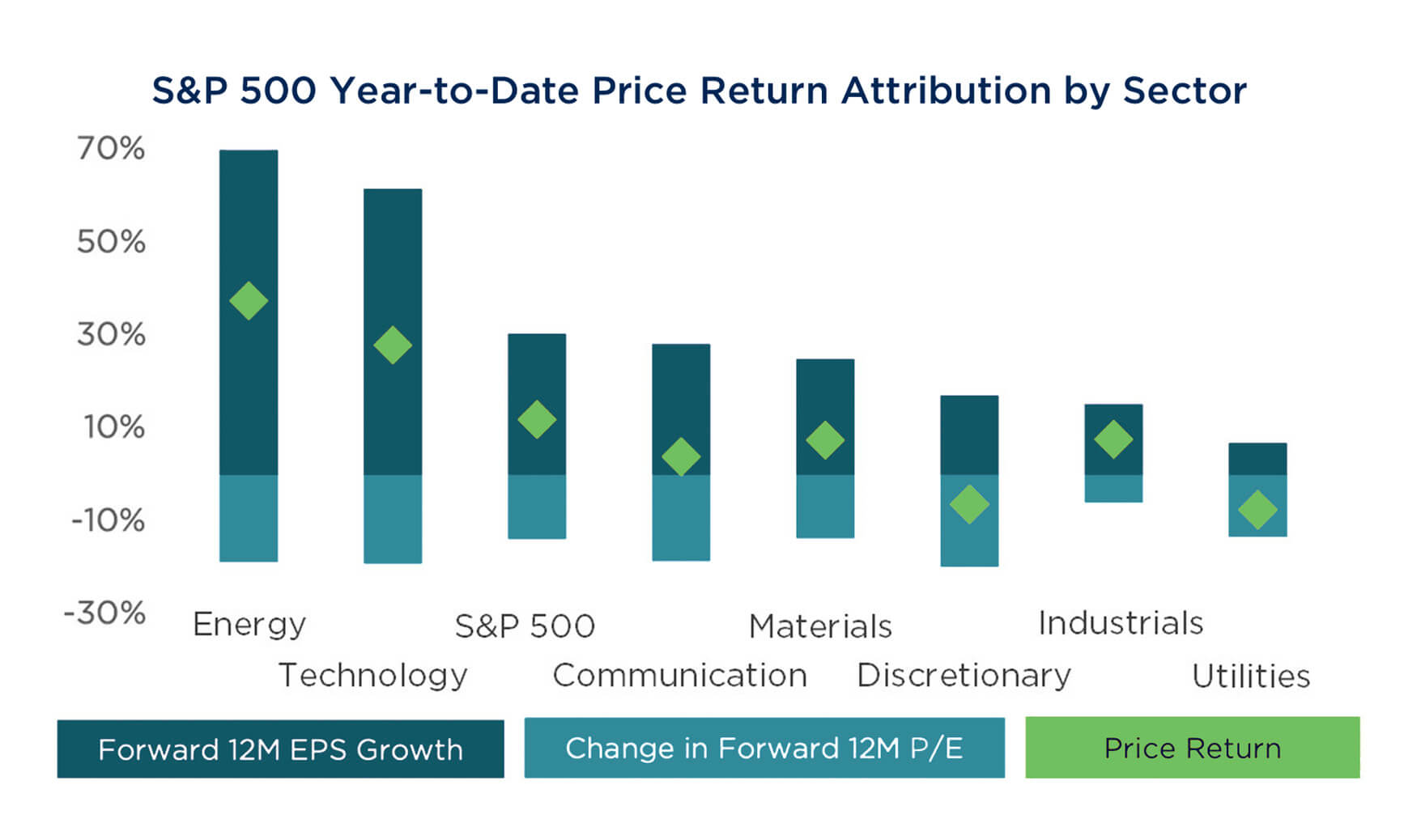
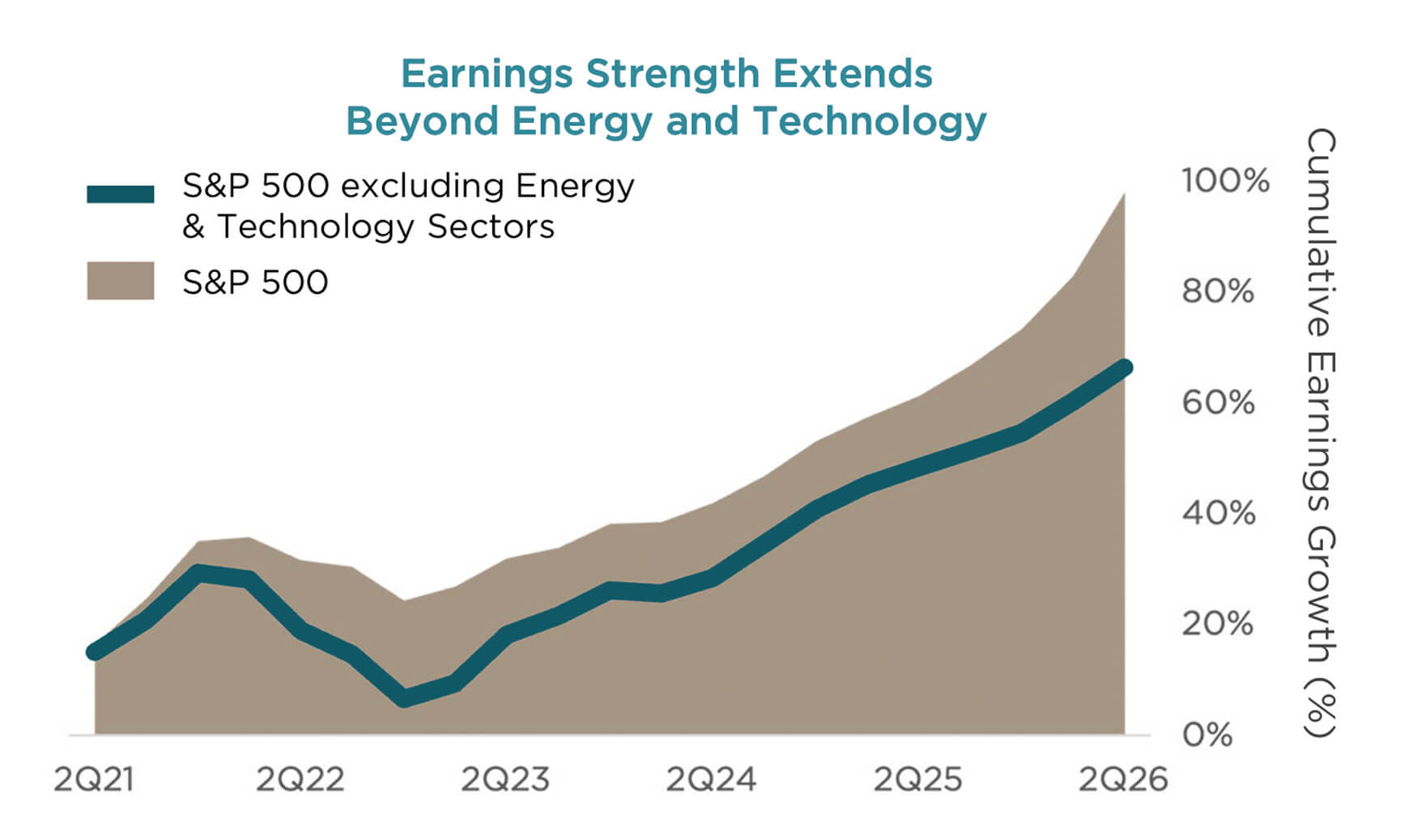
- Corporate earnings are expected to rise 30% in the next year, accelerating meaningfully from growth achieved in 2025. This increase is driven by companies tied to the AI capex cycle and energy. Market pricing reflects this concentration, with the S&P excluding AI-enablers up just 6%.
- Amid rising concerns about returns for the Magnificent Seven, massive ongoing AI investment has been a powerful revenue driver across the AI-infrastructure supply chain and is unlikely to slow in the near term. Semiconductor and semi-equipment companies have been the primary beneficiaries, with technology hardware, industrials, and utilities also seeing earnings boosts.
- As oil prices climbed in line with Middle East tensions, energy companies saw earnings strengthen, while the broader market faced margin pressure from higher input costs. These effects may prove temporary if conditions in the Strait of Hormuz stabilize.
- The durability of broader market earnings growth may be tested as fiscal support wanes and higher input costs take hold.
Sources: FactSet, CAPTRUST research. Sector returns as of 9.30.2026. Right Panel: S&P 500 excluding Energy & Technology utilizes State Street Energy Select SPDR ETF (XLE) and State Street Technology Select SPDR ETF (XLK) to represent the sectors.