


As we share our latest quarterly investment update, I’m reminded that successful long-term investing is rarely about any single quarter. It is about maintaining discipline through changing markets, staying focused on the purpose behind the assets entrusted to us, and making thoughtful decisions with a long horizon in mind.
At the Florida United Methodist Foundation, we take that responsibility seriously. Every dollar we manage represents more than an account balance—it represents the generosity of people who care deeply about ministry and the resources churches and organizations depend upon to carry that ministry forward.
Our investment program benefits from multiple layers of professional expertise and oversight. CAPTRUST serves as our investment advisor, while Hardy Reed serves as our Outsourced Chief Fiduciary Officer (OCFO), providing independent fiduciary oversight and helping us maintain strong governance and investment processes. Together with the Foundation’s Investment Committee and staff, these relationships help ensure that the assets entrusted to us are managed with diligence, accountability, and a clear focus on the long-term objectives of our investors.
While markets will inevitably move through periods of optimism and uncertainty, our approach remains consistent: thoughtful stewardship, strong oversight, appropriate diversification, and a commitment to keeping our investors informed.
In the information that follows, you’ll find an overview of the quarter, portfolio performance, and perspective on the forces shaping today’s markets. I hope this update gives you both useful information and continued confidence in the care with which your Foundation approaches this important work.
As always, our team remains available to assist you. Whether you have questions about your current investments, would like to review your organization’s investment strategy, or simply want to talk through what today’s markets may mean for your ministry, we welcome the opportunity to connect.
Thank you for the trust you place in us—and for allowing us to serve alongside you in supporting and empowering the growth of Christian ministry.
ECONOMIC OUTLOOK
| Investors entered 2026 with high hopes for tax relief, investment incentives, and lower interest rates. However, geopolitical tensions have complicated the outlook, with rising energy prices diluting the impact of fiscal stimulus and reigniting inflation. Investment in AI remains a standout, supporting economic growth and profitability across the supply chain. Still, market leadership is increasingly concentrated, and the new Fed Chair faces the delicate challenge of determining whether recent inflation pressures are temporary or persistent. |

HEADWINDS
The Cost of War
- Inflation has reaccelerated as geopolitical conflict pushed energy and related prices higher. As tensions ease, consumers and the Fed are focused on whether these shocks will anchor higher long-term inflation or prove temporary.
Consumers Feeling the Squeeze
- Sentiment has eroded as wage growth has failed to keep pace with rising essential costs (including food, energy, and shelter). Segments of the population have been forced to rely on less sustainable savings and debt levers to maintain spending.
Overreliance on the AI Theme
- Business investment in AI has become the largest contributor to economic growth. Reliance on a single factor introduces vulnerability, as productivity gains have yet to fully materialize. Slowing investment or increasing regulatory scrutiny could pose meaningful risk.

TAILWINDS
Economic Strength Defies Expectations
- A steady labor market, an AI spending boom,consistent consumer demand, and ongoing business investment have helped the U.S. economy weather the difficulties of geopolitical tensions and an unclear monetary-policy picture.
Spending Powers On
- Despite weakened sentiment, overall consumer activity continues to trend positively, supported largely by the baby-boomer cohort, which is spending down its accumulated wealth of approximately $95 trillion.
AI Fuels Profitability
- Expectations for AI productivity benefits continue to mount and will likely drive long-term margin improvement. Near term, the stimulative impact of massive capital investment is being felt across the economy.
A WIDENING GAP BETWEEN PRICES AND PAYCHECKS
| Consumer sentiment hit a record low in May, as rising inflation outpaced wage growth, particularly for essential items such as food, energy, and shelter. Despite this shift, spending remains positive, suggesting consumers are relying on savings and debt to maintain their standard of living. Typically, the Fed raises interest rates to combat higher prices, but new leadership adds complexity. Fed Chair Warsh has launched task forces and overhauled communications, leaving investors with less visibility into the future of monetary policy and, ultimately, prices. |
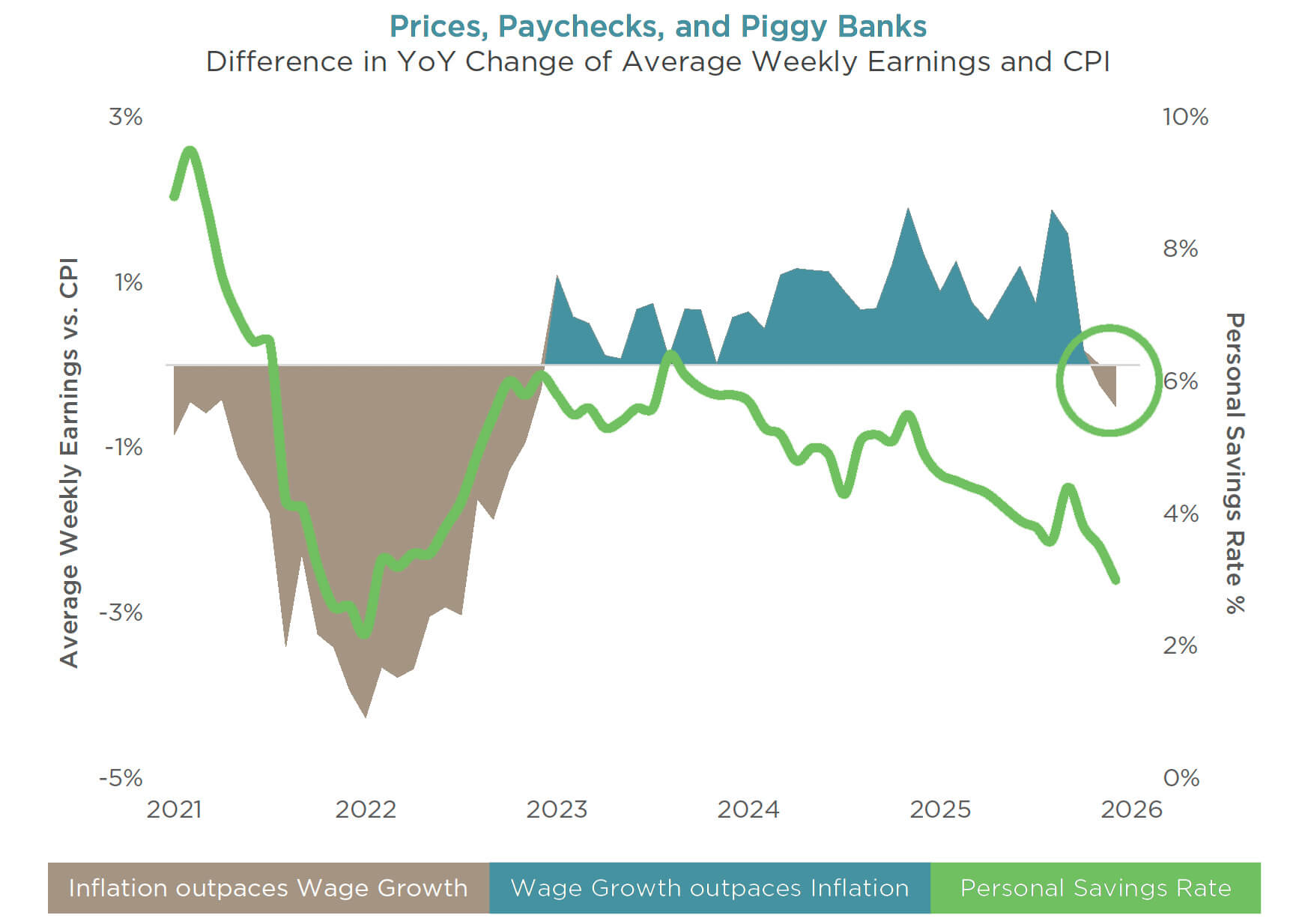
- While wage growth remains positive, it has lagged inflation, with year-over-year (YoY) wages rising 3.7% in May, with inflation at 4.2%. Inflation last outpaced wage growth in the 2022 post-COVID pricing surge.
- As inflation-adjusted wage growth slows, households are drawing down savings, pulling the personal savings rate to a nearly four-year low.
- One major contributor to the declining savings rate is baby boomers spending down their $95 trillion in accumulated wealth.
- On the opposite end of the spectrum, credit card borrowing and buy-now-pay-later usage is climbing, as lower-income consumers with smaller financial cushions lean on debt to finance their spending.
- While geopolitical tensions are easing, the shock from the Middle East conflict is unlikely to reverse quickly, suggesting pricing pressure may persist near-term.
Sources: CAPTRUST research, U.S. Bureau of Labor Statistics, U.S. Bureau of Economic Analysis, St. Louis Fed. The Consumer Price Index (CPI) measures the change in prices paid for a fixed basket of goods over time. Data as of 6.1.2026.
MARKETS FOCUS ON THE POSITIVES
Markets delivered their strongest quarterly results since the second quarter of 2020, as resilient economic growth and robust corporate earnings outweighed conflicting headlines from the Middle East. AIinvestment momentum lifted equities, particularly in emerging markets. The Federal Reserve maintained rates at its first meeting under new Chair Warsh, balancing inflation pressures and elevated bond yields.
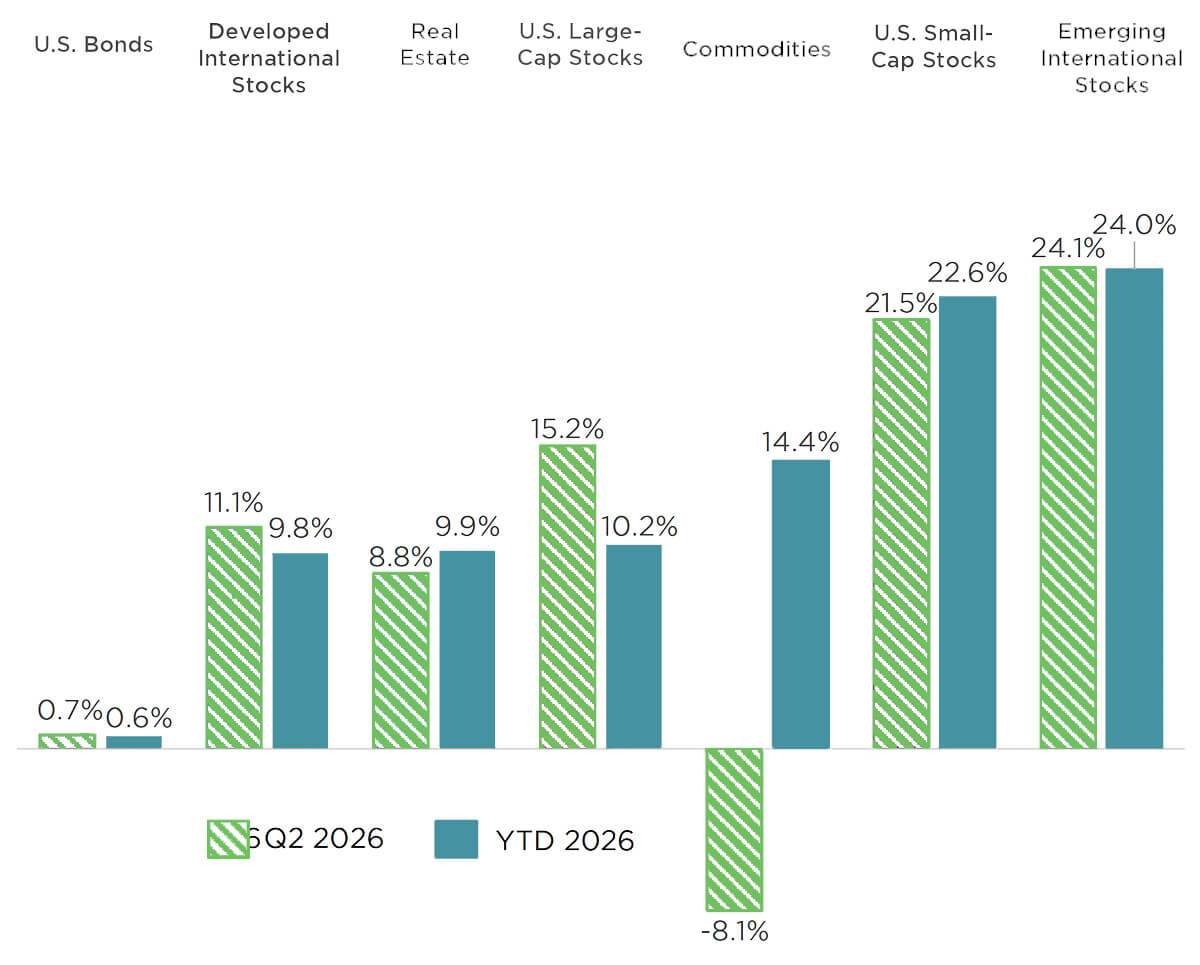
- U.S. large-cap performance was defined by historic growth in AI-related spending and semiconductor demand.
- Small caps gained as improving confidence in the economic outlook prompted investors to move beyond a narrow set of tech winners.
- International markets rallied, led by emerging markets, supported by their positioning in the AI supply chain.
- Commodities were mixed. Energy and gold prices fell. Industrial commodities held firm.
- Core U.S. bond returns were flat as resurgent inflation and evolving expectations for Fed policy weighed on performance.
Asset class returns are represented by the following indexes: Bloomberg U.S. Aggregate Bond Index (U.S. bonds), S&P 500 Index (U.S. large-cap stocks), Russell 2000. (U.S. small-cap stocks), MSCI EAFE Index (international developed market stocks), MSCI Emerging Market Index (emerging market stocks), Dow Jones U.S. Real Estate Index (real estate), and Bloomberg Commodity Index (commodities). Past performance is no guarantee of future results. Indexes are unmanaged; do not incur management fees, costs, and expenses; and cannot be invested in directly. Please refer to the index definitions and other important disclosures provided at the end of this presentation.
ALL IN ON THE AI THEME
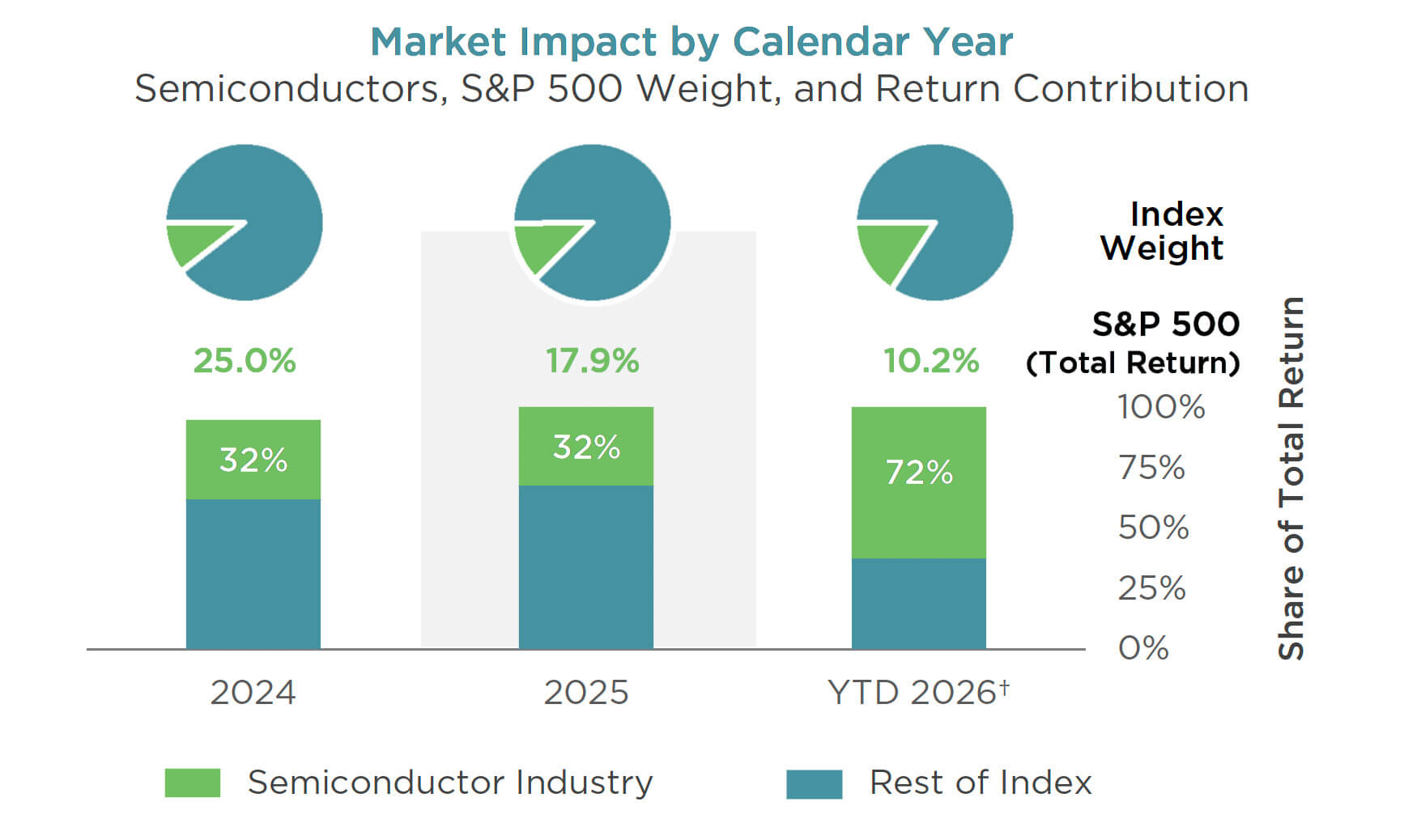
| Technology often leads the stock market, but rarely has a single theme carried so much weight across the full economy. In the first quarter, business investment in computing infrastructure drove gross domestic product (GDP) growth, eclipsing contributions from consumer spending. U.S. AI leadership is a competitive advantage and an economic tailwind, but also a real risk if massive investments fail to deliver on lofty promises. |
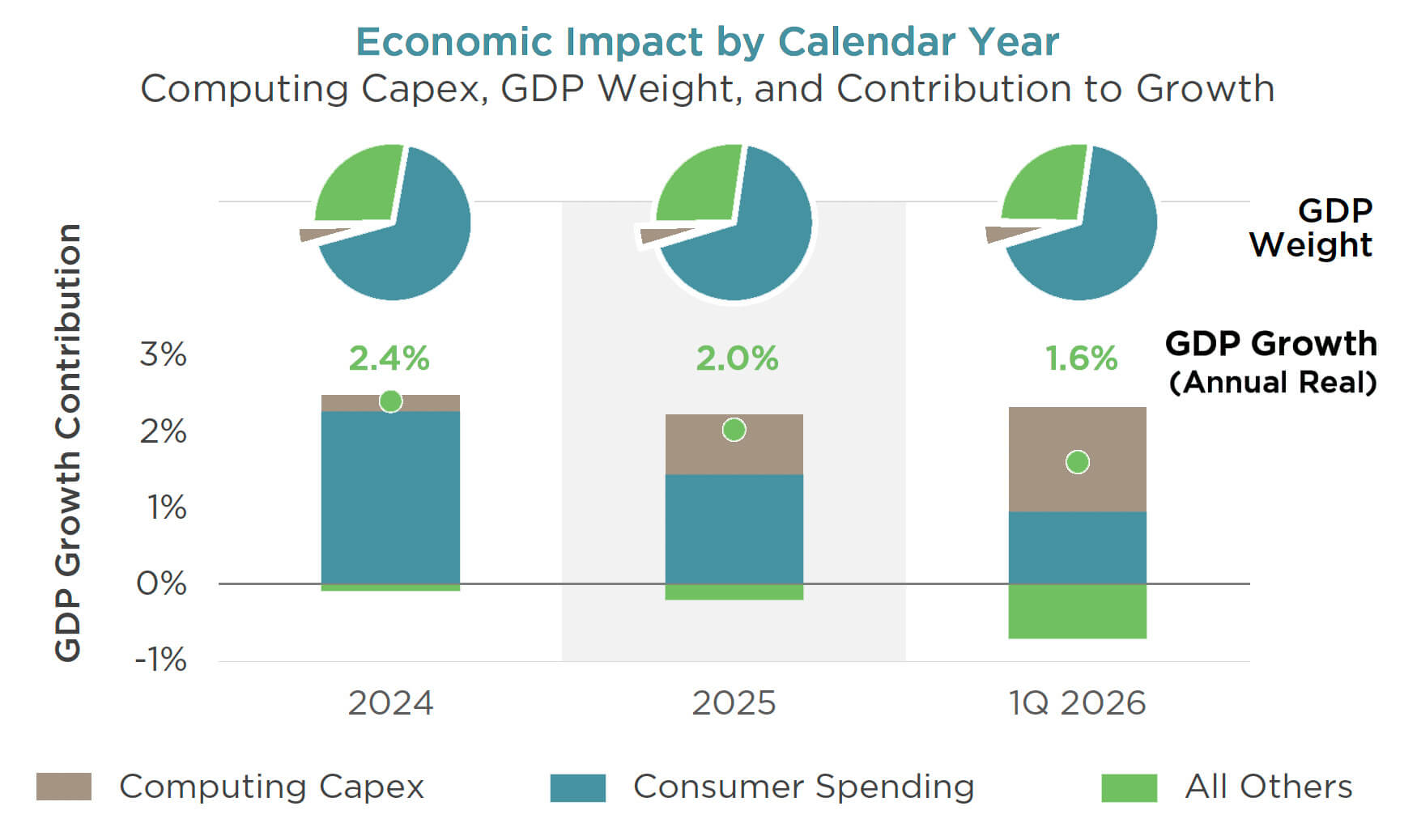
- Although business spending on computing equipment and software represents just 5% of U.S. GDP, it drove roughly 85% of economic growth in the first quarter. Without the impact of the AI buildout, economic growth would have been nearly flat.
- Semiconductor companies represent less than 16% of the S&P 500 by market capitalization but have generated more than 70% of index returns through quarter-end. These results have been supported by real earnings growth, although boosted by extreme imbalances in the supply and demand of memory, plus other key inputs to AI infrastructure.
- Blockbuster AI spending could become a lasting tailwind or a levered bet on new technology and the related business models that have yet to prove they can pay for themselves. The real test isn’t the scale of spending, but the ability of AI investments to generate durable returns for businesses and investors.
Sources: FactSet, CAPTRUST research, BEA, St. Louis Fed. Left panel: Computing capex = private investment in information processing equipment and software. Right panel: Semiconductors and semiconductor equipment industry group (S&P 500 Index). †YTD returns through 6.30.2026.